‘Tughlaki’ Orders: Visva-Bharati teachers oppose biometric attendance, monthly workload report
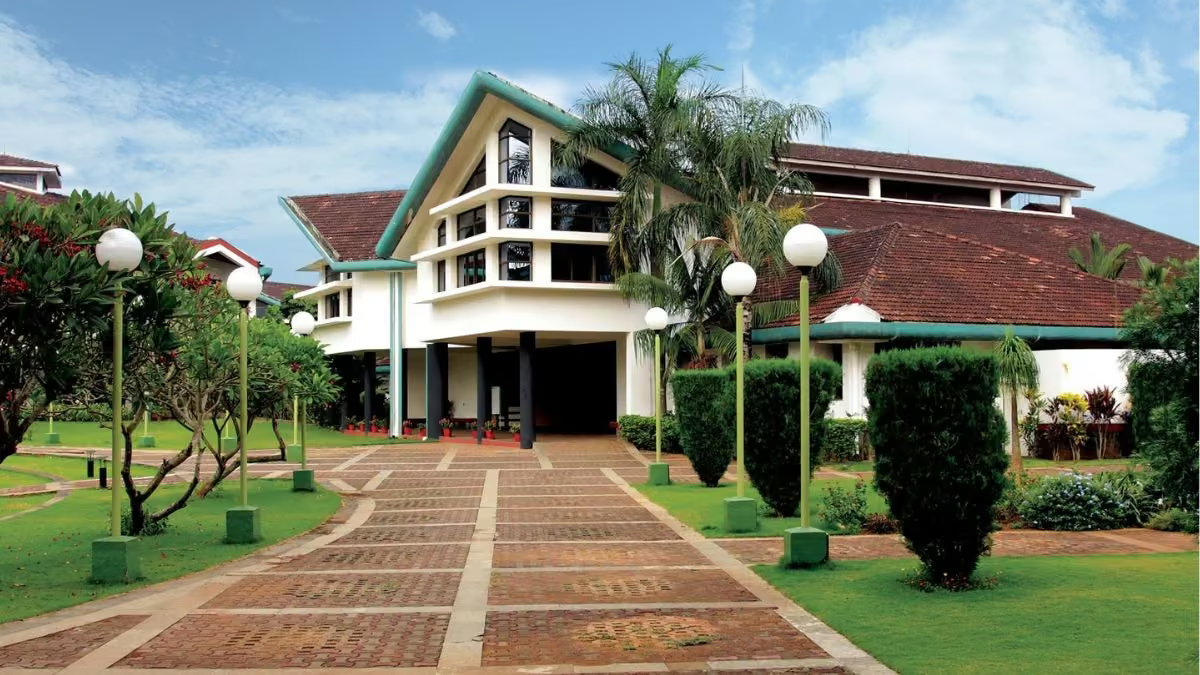
The Visva-Bharati University Faculty Association (VBUFA) has demanded that the university withdraw its recent decisions to introduce biometric attendance for employees and a monthly workload report for faculty members. The association called the measures “unnecessary, uncalled for and detrimental” to the university’s academic environment.
The Visva-Bharati University had on August 6 issued a notification mandating biometric attendance marking for all employees. The next day, it asked teachers to start submitting “monthly workload reports”.
In an August 10 email to Visva-Bharati’s vice-chancellor, Probir Kumar Ghosh, the faculty association said that both administrative decisions were discussed at the general body meeting of teachers on August 8 where they resolved to oppose them.
“We wish to draw your attention to two recent administrative orders concerning biometric attendance and the monthly workload report, which we consider unnecessary, uncalled for, and detrimental to the academic environment of Visva-Bharati,” the email said.
The association said that there was ambiguity over whether biometric attendance would apply to faculty members, but argued that since the notification referred to all “employees”, faculty members would have to assume that it included them.
On August 11, the VBUFA wrote to all faculty members appealing to them not to submit their biometric data. VBUFA said it believed the system was currently meant for non-teaching employees but alleged that the notification had been kept ambiguous to introduce biometric attendance for faculty members later.
Visva Bharati Shantiniketan: Biometric attendance concerns
The VBUFA has questioned the collection of fingerprints for attendance, arguing that fingerprints constitute sensitive personal information and that adequate safeguards must be specified for their storage and use.
The association said that the university's notification did not clarify whether biometric data could be used for purposes beyond attendance. It also raised concerns over data security and alleged that the university had not specified safeguards such as encryption and restricted database access.
“The authority, in its notification…concerning the collection of fingerprints for biometric attendance, has not ensured that the data will not be used for other purposes, such as behavioural monitoring, unrelated surveillance without justification, or secondary tracking,” the letter said.
The faculty body further questioned whether there was any office memorandum, notification or directive from the ministry of education or the University Grants Commission making biometric attendance compulsory. Visva Bharati is a central university. The letter also refers to the Supreme Court's 2017 privacy judgment, arguing that informational and bodily privacy includes biometric identifiers, such as fingerprints.
Against monthly workload report
The VBUFA has further opposed the monthly workload report. According to the faculty association, the university cited UGC guidelines and concerns about punctuality, class schedules, workload and faculty members allegedly taking leave without approval as the reasons for introducing the system.
The association questioned the university’s interpretation of the UGC guidelines, saying they do not require teachers’ day-to-day workload to be documented and submitted by the head of department in the manner stated in the notification.
“We also find no provision in the relevant MoE documents or in the Visva-Bharati Act and statutes that supports the introduction of such a draconian, arbitrary and Tughlaki Monthly Workload Report to be maintained by the Head of the Department,” the letter said.
“More seriously, the proposed system gives heads of departments discretion to record positive as well as adverse remarks concerning individual faculty members, without any clear provision for communicating such remarks to the concerned teacher. The maintenance or forwarding of uncommunicated adverse entries or remarks is contrary to the principles of natural justice,” the letter further said